For years, search engines led all
types of news agencies when it came to finding up-to-date information. Social media on Facebook, Instagram and TikTok followed.
Now a metric being watched points to people using AI chatbots to
find news, rather than going directly to a publisher’s site.
Facebook is still being used, but in the era of agentic artificial intelligence (AI), the chatbots are taking a turn.
Amy Ross Arguedas, senior research fellow at Oxford Reuters Institute for the Study of Journalism (RISJ), and a co-author of the 2026 Digital News Report released Monday, found a sharp increase this year in the
use of chatbots to search for news.
advertisement
advertisement
Last year, the weekly use of generative AI tools across six markets grew from 18% to 34% between 2024 and 2025.
In data collected from this year,
there is evidence of rising weekly use of AI chatbots for news -- up 7% to 10% globally, driven largely by growth in parts of Asia, Africa, and Latin America, as well as Southern and Eastern
Europe.
This is a small minority of the population, but the figure represents a substantial increase and indicates that AI has begun to play a more meaningful role in news consumption.
For now, only 1% say AI is their main source of news, suggesting it currently plays a complementary role for most users, Arguedas wrote in a blog post.
Her analysis examines the emergence
of standalone AI chatbots such as ChatGPT and Google Gemini as a source of news. It also analyzes who uses them, and how these behaviors may shape engagement with, and traffic to, original
sources.
While the research explains the shift to find news on chatbots, it does not analyze how this might affect advertisers. One thing certain, it's clear media buyers will have a new
option, chatbots like OpenAI, as this shift continues. And when chatbots become the preferred trusted news source for readers, they also will become the ad source for media buyers.
Arguedas
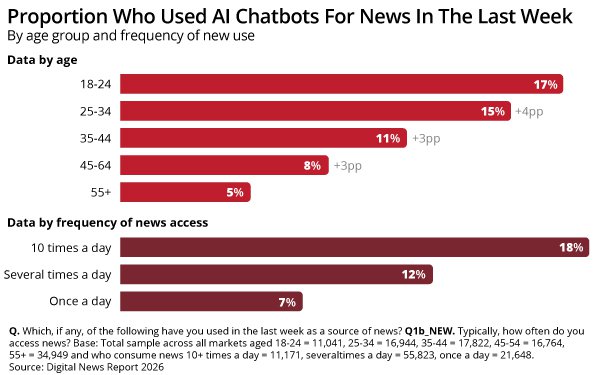
does admit younger people are behind the increase in AI chatbots to search and read news, like what happened with social media.
Some 17% of respondents in the youngest age group use chatbots
for news. It is three times higher than that in the oldest age group at 5%, although the most significant growth compared to the 2025 data occurred among those between the ages of 25 and 34.
Publisher websites are not only losing ground. The report notes authors, news websites and apps saw a 5-percentage point decline in users between 2023 and 2026. This is the only category tracked
that lost users during that time period. Every other platform, including Facebook, YouTube, Instagram, and TikTok, gained.
Trust in the news source also has become a factor. Thirty-seven
percent of people trust most news most of the time, but this year's data shows trust in news from AI chatbots among the general population is lower still at just 20% globally.
For those who
use these tools, 44% of AI chatbot users express trust in news from AI chatbots, compared with just 17% of non-users.
When researchers plotted AI chatbot use against trust, they saw a strong
relationship where markets with higher trust in AI chatbots for news also tend to report higher levels of use.
It also shows that the relationship between trust and use is considerably
stronger for AI than for social media. Meaningful levels of trust are more consistently proportional to levels of AI chatbot use than for social media. A similar pattern is evident at the individual
level. People who trust AI chatbots are several times more likely to use them for news, whereas the relationship is weaker for social media.