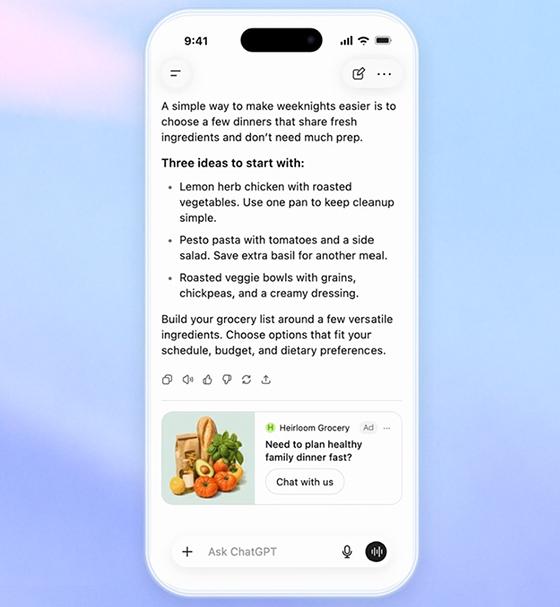
OpenAI Sponsored Agents, which allowed people to start a conversation with a
business-sponsored agent after clicking on a ChatGPT ad, launched earlier this week with new integrations.
advertisement
advertisement
HubSpot joined as the first CRM integration, allowing sales teams to follow up
after the ChatGPT conversation ends, and Shopify, as the first ecommerce partner for OpenAI's ChatGPT Ads product.
These updates represented the next step in automation and
building OpenAI's AI-based advertising platform, making the ads a part of the conversation with brands.
Sponsored Agents give users the option to dig deeper into a product, service or topic. After seeing a
relevant ad, a user can choose to start an ad-labeled conversation with a business-sponsored agent in ChatGPT such as Wayfair, the online home decor and furniture shop.
The user can
explain what matters to them, ask additional questions, and follow a link to the business’s website when they’re ready to take the next step.
Automated ad systems shifting from dashboards to operating infrastructures by flagging ad fatigue, adjusting ad rotations, and executing multi-agent workflows are
next steps in online advertising, all driven by agentic operating systems.
These systems eliminated dashboards as the primary interface and act as a background utility that monitors business
key performance indicators (KPIs) like net profit or inventory levels, and directly alters the ad pipeline in real time.
This produces a massive shift in ad dollars as marketers migrate ad spend toward highly automated systems like Google Performance Max,
Microsoft Advertising Performance Max, Meta Platforms Advantage+, and Amazon DSP Performance+.
Amazon, Google, and Meta now take a combined 58% of the U.S. advertising marketing, up from
56% a year earlier, according to Madison & Wall's estimates.
These three companies have captured a disproportionate amount of market growth during the past year. From high to low,
gains from Google climbed from 28% to 29% of the market; Meta, from 17% to 19%; and Amazon, from 8% to 9%. Other companies combined fell from 47% down to 43%, according to Madison &
Wall's latest estimates.
Automation in these platforms not only condenses the time it takes to discover a product, but the time it takes from search to purchase.
This week Baird Research
analysts attended the BrightonSEO search conference and found how executives at platforms and brands advertisers view the impact of AI apps on the ecommerce shopping journey,
especially across product feeds, AI search, agentic commerce, advertising and attribution.
"Since AI interfaces surface materially fewer products and merchants than traditional search,
structured product data and third-party content are increasingly critical to gain visibility, strengthening infrastructure controlled by Google and Shopify and content owned by platforms such as
Reddit," according to the Baird Research note.
But despite the strength of AI-driven platform from Amazon, Google, Facebook and others, marketers can still see strong performance running
programmatic in-app campaigns on the open web.
Zoomd, a mobile app platform, provides an example of a performance campaign that ran on its demand side
platform (DSP). It shows that ran during the first half of 2026 vs. the first half of 2025. The company achieved a 27% improvement in the number of users who made a first deposit for a gaming app via
campaigns that ran across the open web.
The campaign that ran in the first half of 2026 achieved 446 new first time users vs. the 351 who did so during the first half of
2025. The data is supported by research from ecommerce marketing measurement platform Fospha, which found that marketers who invested between 21% and 40% of their marketing budgets outside of
Google and Meta achieved the best user acquisition costs.
Zoomd shared data that showed the challenges of advertising within walled gardens, such as an increase in user
acquisition costs on Meta, Google, and TikTok, as well as measurement issue of walled gardens managing their own measurement and inflating conversion counts.
Siloed tracking
within each platform creates a double-counting problem where multiple networks claim credit for the same customer journey, causing combined dashboard metrics to overstate actual sales by 1.5x to 2x compared to
backend CRM records.
A little surprising, but data from marketing measurement platform Lifesight confirmed that every platform overcounts conversions. Meta reports 26% more conversions than
independent analytics tools and Google over-attributes by 15% to 20% when enhanced conversions or consent mode V2 is active, according to Lifesight.
It
makes sense that the most effective mobile user acquisition campaigns are those running within walled gardens and across the open web, but many marketers are underinvesting in the
open web because it’s easier to advertise exclusively on Meta and Google.