It has been only 19 months since I first wrote about the ad industry shifting from using AI to reach consumers to using
marketing to reach AIs, and it is evolving more quickly than even I imagined.
That was evident at several recent industry events, especially the Association of National Advertisers' AI
conference last week, and its measurement and analytics conference this week, where numerous speakers spoke about the rapid shift from targeting people to targeting bots.
Honestly, I still
think many miss the real point -- and opportunity -- with so-called A2A (agent-to-agent marketing), because they are still looking at advertising as an asymmetrical market in which advertisers target
others on a one-way street. The only difference is that the others increasingly will be AI agents, not people directly.
advertisement
advertisement
That logic misses the notion that A2A will evolve into a symmetrical
marketplace in which agents on both sides -- advertisers' and consumers' -- will interact with each other to do what advertising has done all along: generate awareness, engagement, trial, and ideally
long-term, sustainable relationships between consumers and brands. Except it will be their agents that are doing all the haggling, leaving the humans on both sides to have the sustainable, real-world
relationships.
In that model, it's not necessarily a one-way street in which a marketing agent seeks out and targets a consumer's agent.
More often than not, it could happen the other
way around.
When I listen to big industry thinkers talk about the shift, they tend to reduce it to tactical "agentic commerce," meaning it's just about agents on the two sides haggling over
the purchase of something. I think that's shortsighted and misses the real opportunity between consumer agents and brand agents.
In the meantime, the agentic part, at least, is evolving
quickly.
I was struck by Shelly Palmer's presentation during last week's ANA conference, not just because he's one of the smartest guys tracking the evolution of agentic marketing, but because
he nailed an important development
"I just want to walk you through the next part of this," Palmer said midway through his presentation, "which is, marketing to bots.
"I've been
hearing about this all day long and it's important for everyone to understand that, right now -- as of this week -- Similarweb, Cloudflare, pretty much everybody that does these kinds of stats --
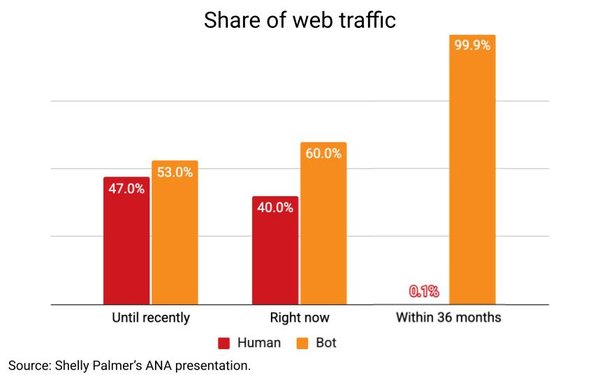
agree we are at about 60% bots and 40% humans" in terms of traffic on the web.
Noting that is up from about a 53%/47% split recently, Palmer went on to project that within 36 months, traffic
on the web will be 99.9% bots, with just 0.1% consisting of humans.
Importantly, Palmer did not distinguish between how much of the bot traffic will be comprised of agents representing
consumers vs. brands, but that's another story I don't think the industry is ready to understand.
In the meantime, Palmer reduced the problem to something conventional marketers could get
their minds around: in a world in which 99.9% of traffic to a website is comprised of bots, he said, "How are we going to change as marketers to deal with a rational actor coming to the site?"
But it was his answer that made me start thinking in a new way: "Well, we're going to need some kind of bot CDN."
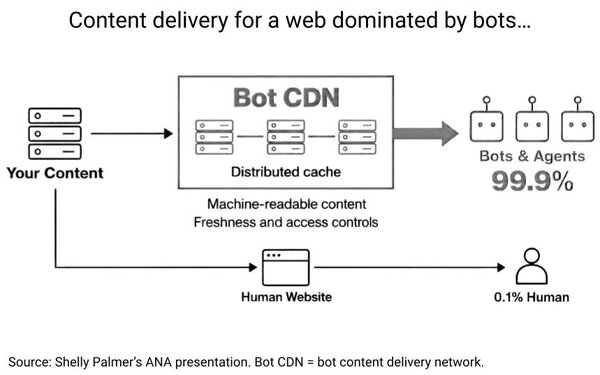
He even showed a schematic diagram envisioning how this bot CDN -- or
content distribution network -- might be stacked (see below), noting: "Where you're routing, specifically, bot traffic to a bot-centric environment that is completely tuned to get that bot in and out
of Dodge as quickly as possible and satisfy what it needs.
"Whether or not people actually buy through agents -- or just search through agents -- marketing has forever changed," he emphasized,
repeating: "We are going to need a way to route bot traffic. And service bot traffic."
That last part is not an entirely new epiphany. A variety of sources have been adopting this
logic, but I think many of them have gotten it wrong, until Shelly Palmer, of course.
Take the "two audience problem" that Contagious championed at the Cannes festival earlier this year. Or
more recently, Time magazine's decision to publish two versions of its site -- one optimized for humans and one optimized for bots -- and the LLMs calling foul over that.
If Palmer's
projection is correct, the two-audience problem will be minuscule, because 99.9% of web content will be tuned to be machine-readable, agent-optimized content. And only 0.9% of it will be tuned for
humans.
I know that might seem like a stretch, but one of Palmer's other points is that the volume of data being published online will also grow exponentially, so the volume of the 0.1% may
not change that much, but the 99.9% will.
If you had a chance to listen to Palmer's presentation, you can hear his own anti-anti-data-center soul-searching about that too, but that's not what
this column is about. It's about the reality that the next iteration of digital media is not one that will be optimized for you and me.
It will be one optimized for our agents.
So you better start building your CDN now.