For years, Meta Platforms employees have given much thought to
managing digital legacies long after a member has died. Now artificial intelligence could make it easier.
Facebook, a Meta company, initially created an approach in 2009 to managing
accounts after a member's death. It introduced the ability to "memorialize" a profile.
Theoretically, the feature froze the account to prevent it from appearing in public spaces such as
birthday reminders or advertisements, but still allowed friends of the deceased to share memories on their timeline.
"Legacy contact" allowed people to manage the accounts of deceased
members. During the company's metaverse period, in 2023, an interview with podcaster Lex Fridman described how Mark Zuckerberg wanted to create virtual avatars for deceased people.
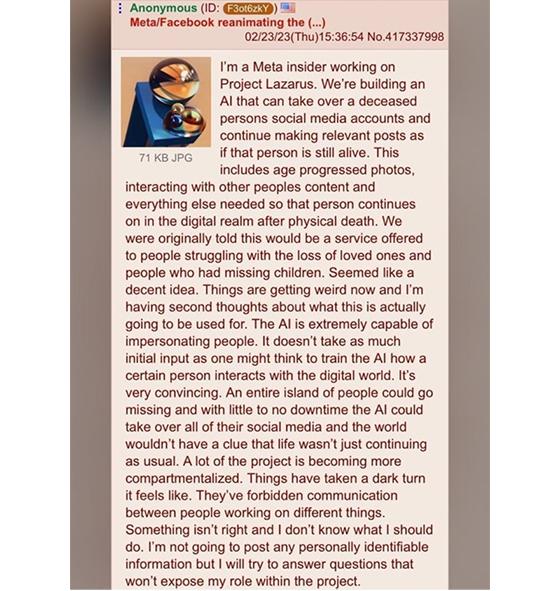
Three years ago, Meta called the idea “Project Lazarus.” Andrew Torba, CEO of social media site Gab, posted a copy of the original image posted by an unknown source that did not reveal
their role within the project.
advertisement
advertisement
Now a patent titled "Simulation of a user of a social networking system using a language model" has surfaced. Business Insider found that it was granted
to Meta Platforms in late December.
The primary inventor, Meta CTO Andrew Bosworth, has outlined how a large language model (LLM)
could "simulate" a person's social-media activity, such as responding to content posted by live people, and then could respond to those posts.
Meta's filing suggests this could maintain
community engagement and reduce the "severe and permanent" emotional impact on followers when a user passes away. It also considered the periods when a person takes a break from posting on the
social-media platform.
This would depend on whether the account had been reported to Meta in terms of the ad server continually serving the member ads. The ad server’s behavior only
changes based on the account’s status, according to the company.
If the account has not been memorialized or deleted, it remains "active" in the system and may continue to receive
targeted advertising, which creates wasted budgets for advertisers.
"We have no plans to move forward with this example," a Meta spokesperson told Business Insider. But the patent
describes a digital clone of the person’s social-media presence, training the model on "user-specific" data — including historical platform activity — comments, likes or content.
In the patent's exact words: “A social networking system simulates a user using a language model trained using training data generated from user interactions performed by that user. The
language model may be used for simulating the user when the user is absent from the social networking system, for example, when the user takes a long break or if the user is deceased.”