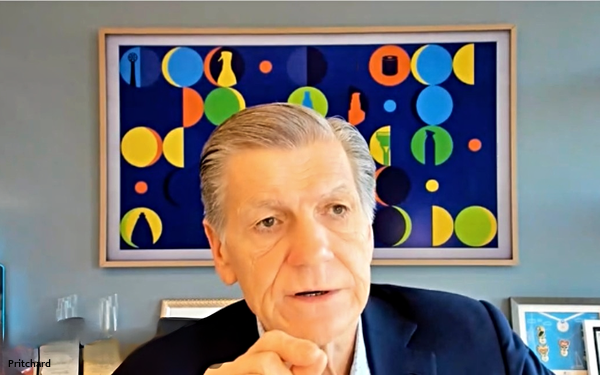
Ahead of the Association of National
Advertisers’ Media Conference in Nashville this week, MediaPost spoke with Procter & Gamble Chief Brand Officer Marc Pritchard about the message he wanted to deliver during a fireside chat
at this year’s conference. An edited Q&A of that conversation follows.
MediaPost: It feels like we're moving into a new Epoch on so many levels: AI,
data proliferation and media fragmentation. Can you just give us the top line of what you're thinking about right now as you head to the ANA media conference? How the landscape's changing, and
specifically how marketers like Procter & Gamble can adapt?
Marc Pritchard: Well, first and foremost, I want to look at it through the lens of the consumers we
serve, because it's really the mindset that we have. What are they experiencing?
advertisement
advertisement
And what they're experiencing is significant, perpetual shifts in media and information fragmentation. The
convergence of media and commerce. And all of that has really turbocharged media, advertising and ecommerce through data and AI.
And although those shifts have been in motion for some time,
this turbocharge of data and AI is leading to a new S-curve of brand building. A transformation of brand-building to a continuous flow of how we engage consumers on a far more one-to-one basis. And
connecting our brands directly to commerce -- to retail.
We saw that merge happen in China over the last several years, and it’s now happening at a rapid pace. We’re
starting to see it happening in places like India, and places in Southeast Asia. And we’re seeing it rapidly happen here in the United States. It creates a kind of exciting way of operating,
because every brand-builder now has the opportunity to be a direct-to-consumer entrepreneur.
Your hands have got to be on the keyboard right now, engaging with consumers on a
day-to-day basis and really helping them understand everything about your brand -- not only your own voice, but the voice of experts and also the voice of consumers who are creating awareness for your
brand and then driving them to be able to instantly buy.
MediaPost: It sounds like you’ve shifted to an agile marketing strategy -- a startup-like culture
competing with D2C brands on their own turf. Is there an agile media strategy that goes with that? And how do you actually execute it?
Pritchard: We made a pretty
big shift a few years ago when we moved almost all of our media-planning analysis -- and in some cases buying -- in-house, because we needed to be more agile.
We also had all the data that was
available -- vast databases that really enabled us to do the planning and do the analysis and then do the buying, particularly programmatically -- and then engaging with key retailers and retail media
partners who have the capability to basically build media plans that could be much more responsive.
It’s not just agile media. It’s agile media connected with agile
advertising and content creation, which is also connected with the agile influencer and community management and then connected to retail. Media professionals need to be more than just media
professionals.
They need to be brand-building professionals, and they need to have the expertise in media. We have some amazing players, but they have to deeply understand how to connect with
consumers across all of the different mediums and how to drive them to purchase, through the connection to retail. That becomes a really far richer job than what we used to have.
MediaPost: You’ve also mentioned how you're utilizing data and AI in a way to activate these campaigns and media strategies at a higher level. We recently reported on new
research from Omnicom, which found that a third of consumers are skeptical and now assume anything they see on a digital screen is generated by AI.
You have some of the most trusted brands in
the marketplace. How do you manage that in a world of increased consumer skepticism about anything they see from anybody, including brands?
Pritchard: Let me start
with how we use the tools of AI to build brands and then get into the content component of that. We have our huge database of insights about the consumer.
What that data, combined with AI
tools, allows us to do is to be able to take the engagement we have with consumers and marry the data we have to come up with insights and ideas and prototype ads very quickly -- sometimes in minutes,
sometimes in hours, sometimes in days -- which then allows us to be able to quickly prototype communication and then create fast cycle content to drive traffic -- high-quality advertising content
that’s branded.
That uses the capability of AI, and in some cases, what we’ll do is create images, modify images, put backgrounds in place, animate things, and do other
things that communicate, basically, the benefit points that are superior that we’re trying to communicate. We can do it at a scale and a pace that we hadn’t been able to do
before.
When that content or that communication communicates the benefit, and the point to superiority and the beauty of that brand or what that brand or product looks like, consumers accept it.
We just need to focus much more on what you're communicating versus the technology of how you're communicating that.
We use this kind of capability across Old Spice, Secret, Native
-- multiple brands -- and it allows us to be able to do it at a faster cycle and at a very high quality. And consumers are accepting it. And it’s building the brands.
MediaPost: It’s great that you’re proactively communicating to the consumer with it, but you're operating in a world of increased skepticism.
We're moving
into an era where consumers are just going to be more skeptical of everything they see. Are you concerned about that? Is there a defense strategy for it?
Pritchard:
What brand building is about is building trust. So our job is to ensure that we are building the most trusted brands with the highest quality possible and that comes from what we call “three
voices.” The brand's voice, which we’ve had since advertising began. And that brand voice still matters.
But also, you need expert voice -- or voices with credibility --
and that’s where influencers and creators and affiliates and other thought leaders come into play. And those people with credibility can speak on your behalf. So it’s important to build a
relationship with them so that they can speak in an authentic way and what they are saying is credible.
Then there’s the consumer’s voice. When a consumer responds in a
positive way, and in many cases creates content about the brand, that is the ultimate edge of “I trust this brand” -- because they’re really going to tell you what they think.
In this world, because it’s so fragmented, you need to make sure that you’ve got all three of those voices working together to build trust for your brand.
MediaPost: Regarding the proliferation of data and more refined analytics, do you think it is making any difference in terms of marketing efficacy?
Pritchard: Let’s remember the quote from John Wanamaker, “Half my advertising is wasted. Trouble is, I don’t know which half.” That was
150 years ago and sadly, there is still not enough transparency in the media supply chain to know which half.
But we may finally be close to the two most important measurement signals needed:
Retail sales measurement. Cross media measurement.
Give our brand builders retail sales signals and we will make the right investments. If we know where ads are run that are
more directly connected to commerce and get a sales signal, it’s just common sense that we would invest.
We want cross-media measurement because we want to avoid
the annoying, redundant exposure that consumers don’t like and is wasteful for us. But we have a solution -- Aquila.
A low-cost industry solution, developed by industry experts, funded by
platforms and publishers, to optimize reach and manage frequency to eliminate waste. This should be a no-brainer to adopt.
MediaPost: Do you have any parting words
of wisdom or practical advice for your brethren in the room at the ANA conference on how they can prepare for 2026 based on your learnings?
Pritchard: I would say,
get in shape. Get in shape for the sprint. And the sprint is going to be a marathon sprint, because this world has become much more of a continuous flow of activity. And when you're a hands-on
entrepreneur, you're always on.
So I would focus on people getting in shape for the sprint, but also remember that the fundamentals still matter. You still need to connect with consumers and
understand them. Get an insight into their lives and what they need. Create a brand idea that expresses the benefit to them, and why that brand is superior.
And then communicate that
across every touch -- in your packaging, in your product, in every form of communication, at the retail store -- and do that in such a way that it gives them a better value.
Those fundamentals
matter, combined with the technologies and the tools that allow you to do it faster, and with a larger amount of volume at scale.
MediaPost: If I could ask you one
last question, only because I feel like it's a little bit of an elephant in the room. You've been so highly visible over the years with your “doing well by doing good” strategy, and
specifically implementing it through diverse media strategies, but we’re going through a period of transition over the past year in which many marketers have grown quiet about DEI. How do you
reconcile that transition, and what are you doing on your end in terms of implementing on those fronts?
Pritchard: Well, what has happened over the course of the
last several years is that we’ve built in the way we operate to serve all consumers and serve each consumer segment, which is a very diverse range.
And in our categories -- which are daily
use household and performance categories -- your different personal characteristics actually drive your needs, your problems, your habits, where you consume media, what touches you culturally, who you
trust.
Our intention was to build it in and ensure that you know the good we're doing is consistent with our business model, which is that we provide the best possible products we
possibly can to every individual.
What has happened in this environment is that we've made sure we serve everyone. All and each.
It's inclusive, it’s not exclusive, and to quote
Joe Mandese, it's diffusive. It's diffused across everyone. And in a world where you now have the opportunity to personalize, that strategy is going to be really, really good for business.