Generative AI, which continues to
dominate marketing conversations around the world, has trampled its way through BrandZ’s 21st brand rankings, breaking through all kinds of barriers.
The biggest? Thanks to the
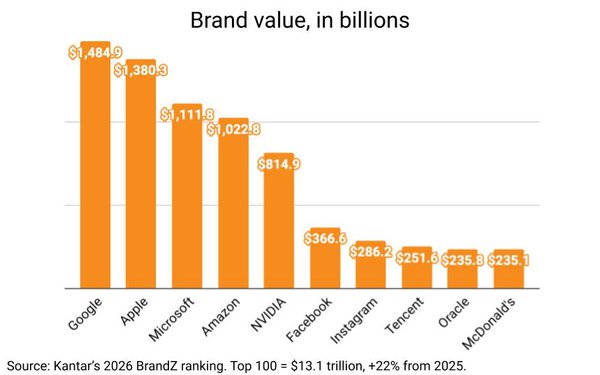
power of Gemini -- now integrated into all its existing products -- Google’s brand value soared 57%, allowing it to boot Apple from the No. 1 spot.
Claude vaults into the global top 100
for the first time, landing at No. 27. And ChatGPT scored the list’s highest year-on-year brand value increase, rising by 285%.
This marks the first time Google has passed Apple
since 2018. “It’s not that Apple has done badly, even though it lost the marquee spot,” says Martin Guerrieria*, head of Kantar BrandZ. “It still grew by 6%.”
But the meteoric growth of artificial intelligence (AI) overshadowed it. Guerrieria notes that it has been a long time since the list has gotten this kind of a shakeup -- specifically, 2008,
when Blackberry grew even faster than ChatGPT.
advertisement
advertisement
Guerrieria tells Marketing Daily that ChatGPT and Claude’s stratospheric rise is not so much a triumph of tech, but of old-school
investments in brand marketing.
For ChatGPT, that includes emotion-driven advertising. And for Claude, that stems from its B2B prowess, and “the meaningful way it distances itself from
ChatGPT, including that Super Bowl ad.”
The other major trend, he notes, is money -- obscene amounts of it. The collective value of the top 100 soared to $13.1 trillion, a gain of 22% on
last year.
Even more impressive: Four of the Top 10 have now shattered the trillion-dollar threshold, with Google (No.1, at $1.5 trillion), Microsoft (No. 3, at $1.1 trillion) and Amazon
(No.4, at $1 trillion) joining Apple, (No.2, at $1.4 trillion.)
For what it’s worth, ChatGPT’s 285% jump might sound record-setting, but it’s not. In 2008, Blackberry leapt
390%.
And while it seems as if tech is this year’s show-stealer, Guerrieria points out that eight of the Top 10 are consumer-facing brands, even if B2B deals are driving much of
their revenue -- which he says underscores the value of brand marketing investments, even as marketing becomes more challenging.

“Marketers are digesting more signals, and it’s less clear
what actually matters. The brands outperforming the market are using AI to bring judgment back into the system, identifying which signals to trust. In a market this fragmented, sustained growth is
coming from clarity.”
While all brands are using AI as a matter of operations and hygiene, “the ones that are successful are those using it to find more meaningful ways to
differentiate themselves from competitors, using those differences to drive growth.”
The year’s list shows other dramatic shifts, including a sharp rise in the value of Chinese
brands, which increased their value by 31%, with one in four of the 100 originating from Asia.
Other notable shake-ups include Zara becoming the world's most valuable apparel brand, overtaking
longstanding leader Nike. And Hermès becomes the most valuable luxury brand, passing Louis Vuitton.
*An earlier version of this article misspelled the Kantar executive's name. He is
Martin Guerrieria.