Cannes Lions International Festival of Creativity kicked off
this week, entrenched in artificial intelligence (AI), from creative to media buying. Advertisers have anticipated display ads powered by large language models (LLMs) across the open web for several
years.
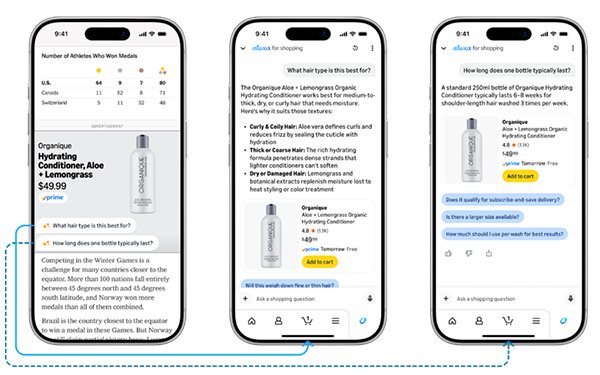
Amazon on Monday released conversational "prompts" in display ads to serve up across the open web.
The company has served similar ads across its properties in March 2026, but
now those prompts are embedded in display ads across the web on sites such as The New York Times, inviting consumers when viewing them to ask for more detailed information about a product.
With AI, Amazon has changed the ad experience during the past year, making each version a richer and smarter experience, Fabrice Rousseau, director of creative experiences at Amazon, told MediaPost
-- emphasizing the "speed of change" for each version, from video to display and prompts.
advertisement
advertisement
"We know from Amazon.com and the shopping app what questions people are interested in
asking about the products," he said. "We feature those questions as a call to action, replacing the old system of [keywords]."
Twenty percent of shoppers who interact with a prompt continue
the conversation, Rousseau said, citing Amazon data, while 7 out of 10 interacting with the prompt are new to the brand. The prompts are personalized based on the consumer and what Amazon knows about
them.
As part of the prompts optimization capabilities, "responsive e-commerce creative (REC)" display ads can automatically generate "Sponsored Products" and "Sponsored Brands" prompts
using images from product detail pages and deliver them across the open internet.
With prompts on REC, a shopper browsing on a publisher site will see a display ad for a product that,
instead of a standard call-to-action, includes clickable questions geared toward the product like shampoo. These prompts could ask "What hair types is this best for?" or "How long does one bottle
typically last?"
Questions are drawn from product detail pages, brand store content and campaign data.
When a shopper taps a prompt, they are taken directly into a conversational
experience with Alexa for Shopping, where they can explore the product, ask follow-up questions, or buy, turning casual browsing into a purchase.
The consumer’s experience with the brand
continues if a consumer closes the browser and then returns later, Rousseau said.
Amazon has also brought agentic capabilities to shoppers, including the ability to alert the consumer when the
price drops on a specific product.
The ads are sold on a CPM basis, and advertisers who opt in to AI automation see a 14% clickthrough rate.
“Think of this as a new way to
engage with advertising,” he said. “You set a price for an item and you can reengage when the price is correct.”