Autonomous functions will become the operating model as
generative AI gives brands an opt-out from browser cookies in this rewired world.
The technological transition is not theory, but rather a way for brands to gain better targeting options from
advertising and marks a transition from digital to agentic commerce.
IDC Global estimates that by 2027, half of programmatic advertising will rely on privacy-enhancing technologies.
Just one year later, 75% of how consumers discover products and services originate from AI-generated summaries. The research firm suggests that digital advertising isn’t evolving
incrementally.
The web is being structurally re-architected for agentic commerce, where success depends less on traffic volume and more on meeting evolving consumer expectations that shape how
shoppers discover and evaluate products.
advertisement
advertisement
In this world, AI agents increasingly discover, evaluate, and purchase products, and advertisers must shift from measuring attention to identifying
purchase intent to guide consumers toward conversions. The optimization of campaigns means AI trust and algorithm'ic selection.
Debra Aho Williamson, founder and chief analyst of Sonata
Insights, tested Meta Platforms agentic commerce app yesterday. In today’s newsletter she wrote: “My test showed me why agentic shopping could catch on quickly. It also demonstrated why
consumers aren’t ready to fully hand over the transaction, and why retailers may not love what happens when agents make shopping more efficient.”
AI links human queries. Researchers have found that AI can identify social-media users who don’t reveal their actual names simply by piecing together clues from their
posts and matching them with details found in other accounts online.
Users of the tech industry forum Hacker News who had posted their LinkedIn profile in their bio. where researchers
stripped out any identifying details, and asked the AI to determine whom each account belonged to using only public information. In the cases where AI took a guess, 252 cases out of 338, it was
correct 90% of the time. This is only one example.
Companies like Ant International, Mastercard, and Visa are preparing for this change. The three are collaborating on a
“Know-Your-Agent” interoperability framework to support agentic commerce across payment networks, digital wallets, agent platforms, and marketplaces.
The framework shares
principles to deploy and identify agents across participating networks to connect proprietary systems, including Ant International’s Agentic Mobile Protocol, Mastercard’s Verifiable Intent
Protocol, and Visa’s Trusted Agent Protocol.
It aims to simplify agentic payment transactions for service providers, agent platforms, and marketplaces while maintaining trust and risk
controls.
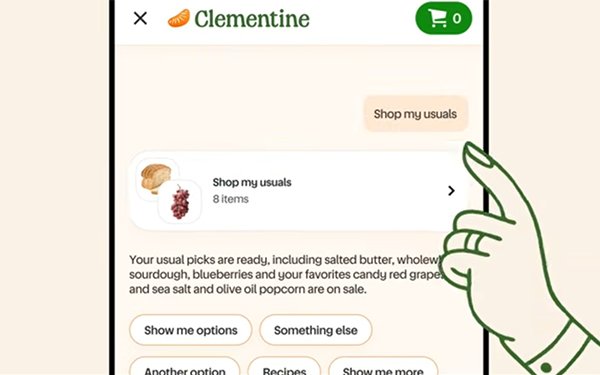
AI will make brand discovery easier. Instacart launched "Clementine AI" assistant this week. The AI assistant factors in data from more than 1.6 billion orders and a catalog of more
than 2 billion items. The assistant uses more than 10 million daily inventory signals from about 100,000 locations across 2,200 North American retail operations.
Instacart, it seems, is
marketing Clementine as a way to discover that consumers want to make for dinner, but brands will find that consumer will discover products from unknown brands so much easier. It's now rolling out to
consumers across the U.S. and Canada on the Instacart Marketplace.
Intelligence behind Clementine reaches beyond
the Instacart app, according to the company. "Cart Assistant" is Instacart's white-label AI shopping assistant, built for grocers wanting to offer their own branded agentic shopping
experience on their website and app. It combines Instacart's grocery intelligence with the retailer’s catalog and customer data to create a branded assistant that knows what customers need,
surfacing relevant deals and recipes, and building carts without requiring customers to search item by item.
Grocers can customize everything from the name and tone to loyalty integration and
recipe content, so the experience feels entirely their own.
Agentic will allow local retailers make available products online. DoorDash didn't announce a new advertising product or media-buying
integration today, but a partnership between its marketplace and local commerce platform, Locally, will enable brands drive demand for products locally.
Locally makes brand inventory at
authorized local retailers visible. Through this partnership, that inventory can now also surface on the DoorDash platform, fulfilled on
demand. The partnership creates another way for brands and retailers to turn online demand into local sales, using inventory that’s already in stores.
DoorDash's news
connects to a broader area Locally is investing in. DoorDash has built Agentic Storefronts for brands, which makes local product availability and fulfillment options accessible to AI
agents when shoppers ask where they can find or get a product nearby.
Customization starts on the backend, the part consumers do not see. Similarweb, known for its data and search services,
and NIQ, a consumer intelligence company, announced a partnership Wednesday to advance agentic commerce measurement with a goal to help brands, retailers and technology platforms to understand how
products are purchased.
Then on Thursday, Similarweb publicly released its State of Ecommerce 2026 report. It combines the company’s monitoring of the digital ecosystem with
Statista’s global consumer research. Combined the numbers provide a map for the evolution of online purchases and what it means for advertisers.
Estimates in the report suggest there
were 11.4% of U.S. shopping sessions using AI as of June 2026 in the United States, up 2.3 percentage points compared with June 2025.
About 23.0% of sessions converted, with 10.5 percentage
points higher than AI-only purchases and 5.7 points higher than search-only purchases in the U.S.
The report examines where consumer journeys are changing, benchmarks sector performance across
key global markets, and what it takes for brands to build a presence across any online interaction, point of contact, or digital channel where a customer or prospect encounters, engages with, or
learns about a brand.