Data released this week examines
agentic media buying in programmatic advertising and how it compares with traditional non-agentic buying across CPM and fill-rate monetization metrics.
Unlike traditional media buying that
often spans broader types of inventory and audience segments, agentic buying takes a more selective approach to inventory and audience targeting because it focuses on the amount spent for
opportunities that align with the brand’s campaign objectives, according to data analysis from DataBeat, a MediaMint company.
Agentic workflows use coordinated AI agents to
autonomously plan, execute, and optimize campaigns in real-time, the report explains.
What makes this so interesting is that by continuously analyzing live performance signals, agentic
technology automates and adapts bidding strategies, inventory selection, and budget allocation for better outcomes against the predefined goals.
advertisement
advertisement
Analysts examined whether this approach
translates into a meaningful difference when it comes to monetizing for better outcomes for publishers using supply side platform (SSP) marketplace data.
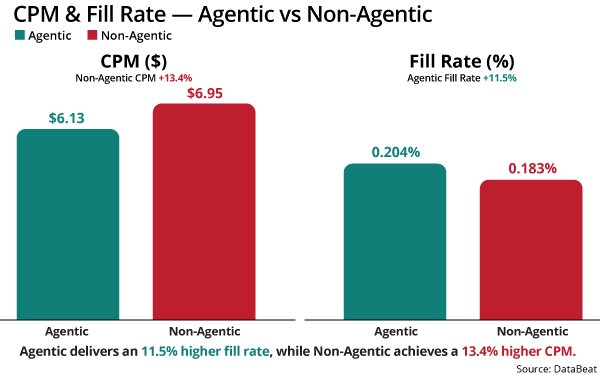
Agentic Buying CPMs were only slightly
lower than non-agentic buying CPMs, although they participated in 86% fewer auctions. This suggests AI-driven buyers are targeting inventory more selectively while maintaining comparable pricing.
Despite participating in significantly fewer auctions, Agentic Buyers achieve a higher fill rate than non-agentic buyers, and they operate on a much smaller share of auction volume than traditional
media buying, yet maintain comparable CPM and fill-rate performance.
DataBeat released data this week after analyzing demand for agentic and the impact on key publisher revenue metrics.
The data shows that in June, users visited publishers less often and viewed fewer pages during each visit, with individuals on average beginning 5.9% fewer sessions on a publisher’s website
or app during the measured time frame compared with the previous period.
On average, similarly, individuals were viewing 7.0% fewer pages, respectively, although sessions remained stable at
1.54, according to the data.
The analysis suggests that while individuals are still arriving on publisher sites and pages, they engage with less content and do not develop strong consumption
habits. This is revealed in the engagement rate, which fell slightly by 3.2%, reflecting an increase in lower-intent traffic, according to the data.
Although the average session increased by
19%, the broader engagement metrics weakened, suggesting longer visits alone are not enough to offset declines in the number of visits and content consumed because of agentic and AI engines.
The “Programmatic Trends Report,” an analysis of anonymous June 2026 data from partners across the DataBeat network, looks at U.S. programmatic advertising performance and trends.
It benchmarks May 2026 results against April 2026 and May 2025, to deliver a month-over-month and year-over-year perspective.
Display CPMs month-over-month rose 5.9% and video CPMs rose
10.5%, contributing to a 6.2% overall CPM gain. Year-over-year display CPMs rose 10.6%, while video CPMs increased 4.2%, producing a net overall CPM increase of 24.2%.
In June 2026, DataBeat
tracked monthly revenue of more than $55 million, 35 billion monthly impressions, and more than 200 monthly bidders.
ChatGPT continued to gain share as a referral source, with its contribution
to total sessions increasing from 0.017% in April to 0.037% in May, while its share of referral traffic grew from 2.1% to 3.4%.