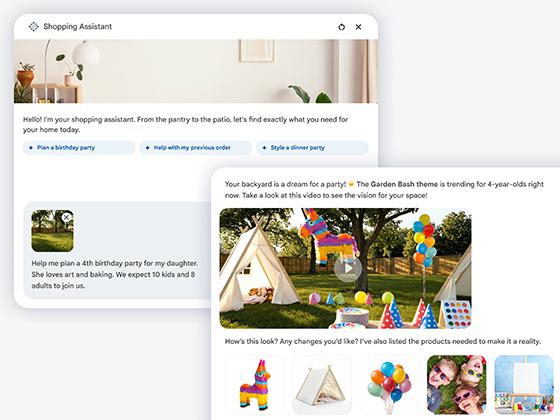
Under its Cloud group, Google will introduce a suite of
products that allow businesses to build, test and deploy personalized multimodal agents.
“Customer Experience Agent Studio” is part of Gemini Enterprise for CX and connects
directly with the Shopping agent to ensure that it integrates historical content from the consumer.
The suite -- one of many announcements that Google will make this week at the annual
National Retail Federation (NRF) 2026 conference -- solves problems in real-time through intuitive multimodal interactions across phone, mobile, and the web in more than 40 languages.
While
Kroger will roll out Gemini Enterprise for CX nationwide to help make grocery planning easier, the Australian retailer Woolworths Group will work with Google to advance
Olive, its virtual assistant to make shopping easier.
advertisement
advertisement
Throughout NRF, Google will share updates in technology supporting agentic commerce and checkouts in AI Mode and in the Gemini
app.
The advancements were made possible, in part, through a co-developed protocol with Shopify.
Business agents will allow shoppers to chat with brands in search is other services,
along with “Direct Offers,” a new pilot from Google that gives advertisers the ability to serve exclusive offers to shoppers who are ready to make a purchase in AI Mode.
Lowe’s and Kroger are early adopters of agentic tools, and pizza restaurant Papa Johns became the first to deploy Google Cloud’s omnichannel “Food Ordering agent.”
The Food Ordering agent is helping the pizza brand deploy a voice and text AI ordering system, which is a part of Gemini Enterprise for Customer Experience, an agentic platform that combines
commerce and customer service.
“Eight-five-plus percent of our orders come in through digital, so we are always trying to think about how to turn a transaction into a personal
experience,” said Kevin Vasconi, chief digital and technology officer at Papa Johns, during a briefing with reporters. “We think this is a beautiful application of multimodal
AI.”
If a consumer is having a party, for example, the agent can determine how many pizzas are required to feed all the participants, taking into consideration any dietary restrictions
or preferences.
In 2024, McDonald’s ended a test using AI to take drive-through customer orders, after the technology showed mixed results. The goal was to automate order taking in
partnership with IBM, but tests ultimately failed to produce expected results.
Open standards support the rollout of agents across retail. Vidhya Srinivasan, vice president and general
manager, Google Ads & Commerce at Google, during the briefing with reporters spoke about launching the “Universal Commerce Protocol (UCP).” This is a new open standard for agentic
commerce that works across the entire shopping journey — from discovery and buying to post-purchase support — which Shopify co-developed with Google.
UCP establishes a common
language for agents and systems to operate across consumer surfaces, businesses, and payment providers. Instead of requiring unique connections for every individual agent, UCP enables all agents to
interact.
Etsy, Wayfair, Target, and Walmart also helped to develop the protocol, and it has been endorsed by more than 20 merchants and brands like Adyen, American Express, Best Buy,
Flipkart, Macy’s, Mastercard, Stripe, The Home Depot, Visa, and Zalando.
Advertisers have the ability to use data from agentic consumer interactions, but this capability is
governed by a new "agent-aware" privacy framework and a shift from traditional tracking to real-time intent analysis.