Across the U.S., football fans are preparing to spend this
Sunday enjoying Super-Bowl-related activities.
Think about it. AI-driven ad targeting is like a quarterback running an offense: reading the defense in real-time, adjusting the play at
the line of scrimmage and throwing the ball exactly where the receiver will be.
Traditional ad targeting is more like a pre-scripted play drawn up days in advance. The play may be solid,
but cannot account for a sudden change in wind or other decisions based on environmental factors.
EDO recently launched an artificial intelligence (AI) agent that can read TV ad performance in
seconds, and rank performance based on budgets, spend data and impressions.
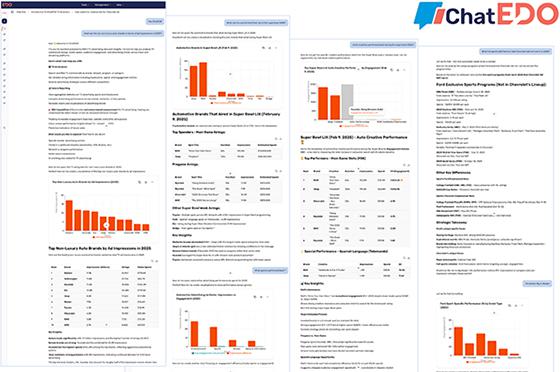
ChatEDO, an agentic AI app interface, is intended to make television advertising more measurable
through natural language queries, and the data faster to access through a dashboard. It works across linear and streaming environments to support advertisers, agencies, and publishers.
advertisement
advertisement
The
chatbot -- designed to support research and insight teams -- should relieve some of the pressure when marketers are attempting to understand data running across data dashboards for TV campaigns.
“Our focus wasn’t just on building a chat interface,” said Joshua Lee, EDO’s chief technical officer and head of product. “It was building the right intelligence
behind it.”
Rather than being tied to one AI provider, ChatEDO can integrate with all types of platforms and foundational models such as Amazon Web Services’ Bedrock,
OpenAI’s GPT-5, and Anthropic’s Claude Opus.
This architecture allows ChatEDO to switch between foundation models as new capabilities emerge, without disrupting the user experience
or compromising accuracy.
The proprietary intelligence behind ChatEDO resides in its tools for model content protocol (MCP), an open-source standard for connecting AI applications to external
systems.
EDO spent years engineering the execution logic and guardrails required to reliably interpret, contextualize, and analyze its syndicated, scaled, and TV data.
Rather than
relying on generic AI platforms, ChatEDO can combine more than 10 years of cross-platform outcome data, trillions of impressions, hundreds of millions of airings, and syndicated benchmarks across
industries, the company said.
This will support agentic systems in predictive consumer behavior, with the capability to turn immediate signals and historical benchmarks into actionable
guidance.
When data is delayed, it’s like a receiver running a play based on
yesterday's strategy while the ball flies toward a different spot on the field. That lag causes the ball to slip through the player's fingers and bounce toward the competition -- and it
can turn a successful strategy into disaster.
A special thanks to Google AI Mode for helping me understand football a little better.