TiVo Ads President Matt Milne believes
the scale and engagement of the company's footprint remains largely unreachable via traditional connected television (CTV) media buys, and that deterministic viewership data across
screens helps brands find audiences they were not currently reaching.
The company, under its parent Xperi Holding Corporation, will launch what Milne called an “ultimate targeting”
opportunity for advertisers. At a household level, it will target ads in the home and in the car.
“Today, we are building an entertainment platform, but in the future it will let us
bring the ads into the car and target ads in a privacy way through a household ID,” Milne said.
Millions of cars are supported by Xperi’s company that have a smart TV in the
dashboard. It was originally launched with BMW, supporting FAST channels that are in the car, and then at CES 2026, TiVo announced adoption by Mercedes-Benz. Information goes into the car, and Xperi
receives that information back in a loop.
advertisement
advertisement
As of early 2026, the Xperi DTS AutoStage platform supported more than 14 million vehicles worldwide, up from 10 million in early 2025. HD
Radio receivers are implemented in about 110 million vehicles globally and 100 million in the U.S.
DTS AutoStage is a global in-car entertainment platform that combines radio, audio,
video and gaming content.
Making it possible means combining many of Xperi’s companies.
“We are seeing five-ish hours being watched daily per device,” Milne said,
adding that these platforms now allow the company to collect data from its platforms.
It began in the late 1990s and early 2000s when TiVo became a verb -- TiVoing it. People began
pausing live television and recorded content.
This gave TiVo Ads a jumping-off point. It started in the ads business in early 2000s, but it was “rather limited” until recently,
about 2020, Milne said.
The company’s entertainment platforms allow TiVo to collect deterministic data about what people watch, from home to cars, which builds off the HD Radio
franchise. It provides insight into the consumption of content, giving TiVo second-by-second clickstream data.
This provides a foundation to connect advertisers with consumers, whether at home
or on the go, while using the data in “a privacy centric way.”
TiVo has become a “powered by TiVo” company, Milne said. “We let our customers, even for
advertisers, be the main brand. The notion of being independent tells them we will never build our own TV or run an operator or provide content.”
This becomes an interesting opportunity
for advertisers to improve performance for ads by connecting the home with the car, not the mobile phone.
There are a variety of TV providers latching on to this opportunity. Samba TV struck a
deal with TiVo, owned by Xperi, earlier this month to strengthen connected TV advertising in the U.K. It combines Samba’s audience data and analytics with TiVo’s CTV inventory.
On
April 1, TiVo became a preferred managed service advertising partner for Samba, while Samba became a preferred analytics partner to Xperi.
TiVo will integrate its owned and operated ad
inventory with Samba’s data and analytics tools to offer brands and agencies audience targeting and campaign measurement. The initial focus is on the UK, but the companies suggested the
relationship has wider global potential.
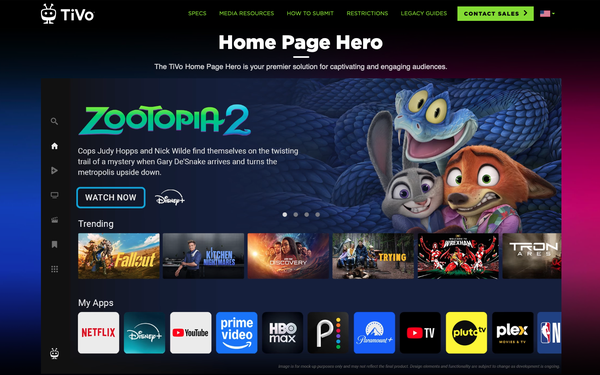
Earlier this year, TiVo also launched new offerings from its ads division, TiVo Ads, providing advertisers with ways to use full screen video
advertisements and shoppable QR codes. The group’s footprint spans more than 100 TV brands, dozens of operators and more than 5.3 million monthly active users.