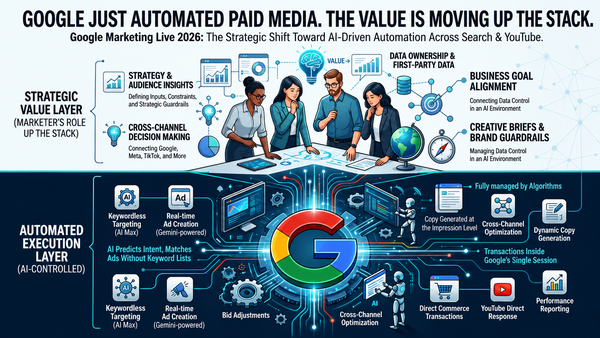
Google Marketing Live 2026 didn't just introduce new
products; it clarified the direction of the media landscape. Google is moving aggressively toward AI controlling the full execution layer across search and YouTube. That shift goes far beyond paid
search.
It signals a structural change in how campaigns are built, optimized, and measured. Four developments define this moment.
First, keyword management is being
automated. AI Max represents a move toward keywordless campaigns where AI predicts intent and matches ads without human-built lists. The manual levers agencies have historically managed --
match types, negative keywords, bid adjustments -- are increasingly handled by machine learning.
Second, ad creative is moving into the auction itself. Google's Gemini
model generates copy in real time based on individual queries, replacing the traditional write-test-optimize cycle with dynamic generation at the impression level. The role of marketers shifts from
producing assets to defining inputs: briefs, guardrails, and brand controls.
advertisement
advertisement
Third, Google is collapsing the purchase funnel. With Universal Commerce and direct offers, users
can move from search to transaction inside a single session. The platform is no longer just a gateway. It is becoming the destination.
Fourth, YouTube is being repositioned as a
direct-response engine. Google is pushing it beyond brand awareness into performance media. Tools like Asset Studio generate video variations from a URL, while integrated shopping features
enable direct checkout from video.
Taken together, the execution layer of paid media, targeting, bidding, creative production and reporting is being automated. That creates a new dividing line
in the market.
The automation of execution does not reduce the need for expertise, but raises the stakes. When platforms handle the mechanics, the decisions above them determine
outcomes: Which channels deserve budget, what the AI is told to optimize for, what guardrails protect the brand, and whether reported results reflect real business growth or just platform activity.
These require judgment, cross-channel perspective, and accountability that exists outside any single platform's interest.
This matters because platforms are not neutral. Google's AI
optimizes for Google. It will not recommend shifting budget to other channels, flag creative drift, or pause spend when performance misaligns with business goals.
That independence is exactly
what strong agencies provide, and it becomes more valuable as automation accelerates.
Data ownership is the second critical differentiator. Much of what Google is building depends on brands
feeding first-party data into centralized systems that improve targeting but may also train shared models.
Some brands will accept that tradeoff. Others will prioritize control, driving demand
for independent approaches.
Publicis' acquisition of LiveRamp makes the same bet from the other direction: own the data and identity layer, and you own outcomes.
Paid media is not
disappearing. It is being restructured. What gets automated is execution. What grows in importance is everything above it.
The brands that win will be the ones that recognize the
difference between a platform executing on their behalf and a partner thinking independently on their behalf. Strategy, curation, and judgment cannot be automated.
In a market where every
competitor has access to AI, that independent thinking is the only edge that matters.