Google’s multi-year contract with Apple to support its push
further into artificial intelligence (AI) gives the company access to more than 1.5 billion iPhones worldwide. The number is an educated guess based on analysis and available
numbers.
As a Gemini-powered Siri becomes a primary interface for Apple users, and the focus shifts from traditional search to answer engines, BrightEdge CEO Jim Yu believes that for the first
time since the surge of AI-powered search, the market is consolidating around players with deeper ecosystems.
Deep ecosystems, a term reserved for companies such as Google, Microsoft, and
maybe Meta Platforms, will have key implications for advertisers and Apple’s ability to tap into many of Google's AI retail services. Google recently announced such as Direct Offers in AI Mode,
and integrated checkout functions made possible by the collaboration with Spotify.
advertisement
advertisement
AI is transitioning from investment to practical U.S. application in advertising, marketing and data,
according to an annual report from the strategic consultancy Winterberry Group.
Overall media expenditures are predicted to top $664.2 billion — up 9.4% compared with 2025.
It will continue to push market share shifts from offline media to digital driven by data channels.
The advertising marketplace in 2026 will also see gains from the World Cup, Winter
Olympics and U.S. midterm elections, according to the data.
Political spending will again drive more than $10 billion of spending acting as a further catalyst, lifting the overall ad-spending
forecast from 7.6% to 9.4%, according to the Winterberry Group.
While some advertising insiders believe agentic AI and commerce will overtake advertising, the Winterberry Group released
insights on Thursday suggesting adoption will continue to reintegrate media, creative, and data — forcing agencies to restructure, eliminate silos and increase the tech adoption rate.
As
autonomous decisioning grows, agencies will continue to redefine themselves as platforms rather than service providers.
In other words, agentic will force the redesign of the agency business
model, just as BrightEdge's Yu sees consolidation — or at the very least partnerships — among players with deep ecosystems.
A interesting shift occurred with search ads during
the final quarter in 2024. Tinuiti, an independent performance marketing agency, released its Q4 2025 Digital Ads Benchmark Report, which analyzes the evolving digital advertising landscape
across Google, Meta, Amazon, TikTok, YouTube, and other platforms.
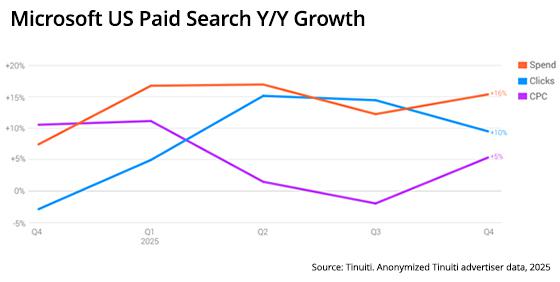
The data shows that advertising investments in Microsoft paid search ads rose 16% year-over-year in Q4 2025, from 12% in Q3
2025, outpacing Google search spending. Microsoft search ad clicks were up 10% in Q4, but down from 15% in Q3.
Average cost per clicks (CPC) rose 5% in Q4, compared with a 2%
decline in Q3. Amazon maintained its presence in Microsoft’s shopping ad listings over the back half of 2025 after having dropped out of Google’s.
Tinuiti data shows that more
dollars will move to TV screens. YouTube video campaign spending dominated in the final quarter of 2025, and some 67% of spending on YouTube inventory purchased through traditional video ad campaigns
was attributed to TV screens, while phones contributed 17% of spending.
This prompts the question of whether Google advertisers will drift into Apple TV — which has not officially
disclosed subscriber figures, although industry reports place the number significantly higher than 45 million.
With Amazon pulling back, according to Tinuiti data, Google search
ad-click growth has reached a near five-year high.
Amazon remained out of nearly all U.S. Google shopping auctions, after dropping out in July. Google click growth hit 13% year-over-year
for Tinuiti advertisers in Q4 2025 — the strongest rate of growth since early 2021.
Looking at pharma and health care, Tinuiti found that Amazon ran only limited U.S.
Google shopping listings for its Amazon Pharmacy arm.
Pharmacy and health care have seen another interesting phenomenon during the first quarter of 2026, with OpenAI launching ChatGPT Health
in beta,
Google Health continues to focus on AI in 2026, moving from general-purpose models to clinically specialized agents that use the Gemini 3 architecture and Med-Gemini.
Google
has done so much in health care in the past year that it is difficult to catch up with all the news, not only in the U.S., but globally.
In a partnership with Apollo Radiology International,
Google’s AI is providing 3 million free screenings for tuberculosis, lung cancer, and breast cancer across India during the next 10 years.
There are other companies in the AI health-care
space, such as Doceree, an AI-powered operating system for health care marketing, which supports in the United States what it calls a “point-of-care (POC) engagement platform”
that focuses on programmatic messaging to health care professionals (HCPs) and patients.
POC for advertisers means having the ability to place ads inside a doctor’s clinical workflow.