AI has lowered the cost of faking a click,
an install, or a conversion and invalid traffic has become more sophisticated and more difficult to separate from the real thing.
Despite feeling confident in fraud detection, marketers
participating in a survey estimate they are losing 27% of their ad spend to fraud every year. This amounts to roughly $3 million annually for the typical survey respondent.
Branch, a company
that built algorithms and statistical models to protect against ad fraud, released the data Monday after surveying where 455 marketing executives from North America, EMEA and APAC stand when it comes
to ad fraud.
While fraudsters will create AI-based fake ads and fraud, companies will use AI to defend against it in very different ways as the technology opens new vectors that
marketers must protect against, Adam Landis, head of strategic growth at Branch, told MediaPost.
advertisement
advertisement
Landis said new fraud methods in a variety of services will emerge that the
advertising industry has yet to encounter. He provided agentic as one example.
Proxy metrics is one of the latest areas, where AI can create improper incentives. This will drive new
loopholes that fraudsters can exploit, Landis said, adding that it gives advertisers reasons to focus on measuring the end-quality of all ad campaigns.
"The AI can’t fake revenue to your
bottom line,” he said. “The closer you can measure the actual performance of your advertising, the more you avoid the aspects of fraud loopholes."
Landis' comments were based
on analysis from Branch's latest report, Ad Fraud In 2026: How Marketing Executives Are Responding.
Branch's report provides estimates on how much it costs marketers to protect
against fraud, how they detect it, and how they have changed the ways they spend marketing dollars.
Eighty-seven percent of marketing leaders participating in the survey said concerns
have increased in the past 12 months, and 98% cite changing the way they allocate or manage their media budget as a result.
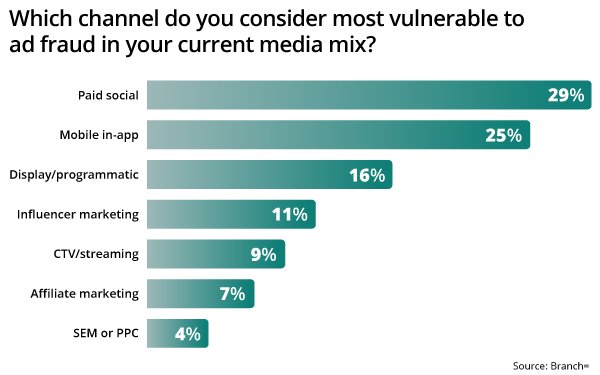
Paid social media is the leading fraud concern for
marketers, but the results for channel vulnerability differ depending on the region.
Social ranks first across all three regions, while connected TV (CTV) ranks near the bottom,
despite significantly higher invalid traffic rates than desktop and mobile web traffic.
Most marketers know AI makes it more difficult to detect fraud, but it is important to remember
that most marketers are still catching up when it comes to detecting this type of fraud and deterring it. Some 83% participating in the study said AI makes fraud difficult to detect, and only 16% said
it is helping them fight back.