At a time when the marketing industry seems
transfixed on the "visibility" their brands have with AI chatbots -- and the sources they draw from -- a leading consumer researcher is turning the tables to understand how consumer behavior is
changing based on how they use AI. And they're using people to do it -- lots of them.
In a major repositioning of its burgeoning AI analytics business, Comscore this morning unveiled plans to
accelerate insights drawn from the 1 million-plus people opting into its digital media-measurement panel.
The panel utilizes software meter technology to track every conceivable keystroke
behavior the panelists make on desktop and mobile media that now includes the major LLM chatbots.
This enables Comscore analysts to see not just what the the bots are drawing from and
rendering, but how people prompt them, the responses they receive, and how they behave as a result of it.
advertisement
advertisement
To date, Comscore has been producing custom analysis and a couple of generalized
reports based on the new "AI-triggered" customer-journey behaviors.
But it already is envisioning a more robust set of standardized studies, reports and even a new syndicated research service
that would be akin to what Comscore and its peers have traditionally provided to brands, agencies and media to understand how people use conventional digital and analogue media, and how their consumer
behaviors evolve because of it.
"Think about it -- a few years back if someone wanted to find something their customer journey was pretty predictable: they went on search, visited a few
websites, read some reviews and eventually bought something. Today, consumers are no longer searching, they're asking. And that simple change is probably the biggest disruption in marketing since
search itself," explains Comscore Chief Analytics and Technology Officer Smriti Sharma, who is leading the new initiative.
"It's not a search. It's a conversation, and that's how marketing is
now capturing intent," she continues, explaining that unlike conventional GEO and brand visibility analytics, Comscore's permission-based panel enables it to see the actual conversations consumers are
having with their chatbots, the iterations of their prompts, the replies, recommendations and source links the bots return, and how their customer journey proceeds to other digital destinations
because of it.
Sharma says it has been a work in progress, beginning with custom analytics requests from Comscore customers, but it already has produced a couple of trend reports, including
one on the travel and lodging category Comscore published earlier this year.
The report contains
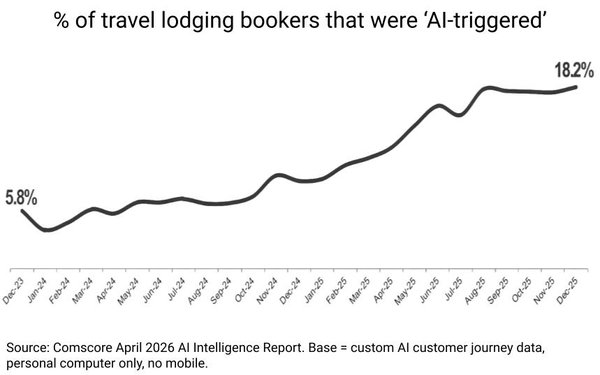
many expected insights about the rapidly expanding adoption and usage of AI chatbots, but it also reveals some new insights about how AI is leading directly to conversions -- consumers making
immediate "AI-triggered" purchase decisions because of a chatbot's recommendations.
For example, the chart above reveals a threefold increase in the percentage of consumers in its panel making
travel-related lodging purchases over a two year period through December 2025.
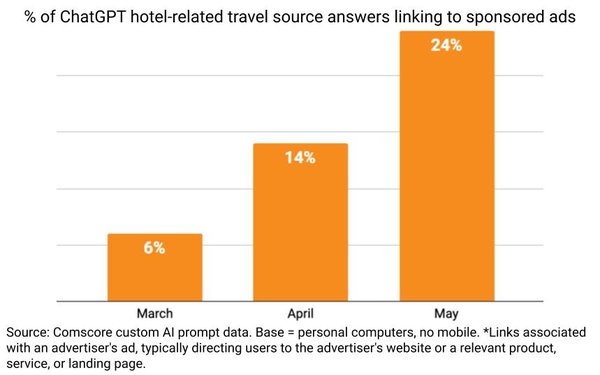
More recent data provided to MediaPost by Comscore reveals the impact sponsored ads are influencing the
AI-trigger effect in the category, expanding four-fold in just three recent months (see below).
Sharma concedes that it is still early days in the evolution of Comscore's AI
marketing intelligence practice, but unlike much of the marketing research industry's focus on AI visibility rankers, the utilization of AI itself to generate "synthetic" respondent data and/or to
conduct simulations of consumer behavior and customer journey outcomes, the data Comscore is mining is based on empirical behavioral data coming from actual people.
"It's the behavioral
measurement of how actual people are using AI. That's the difference," Sharma asserts.
While Comscore's digital consumer panel fluctuates over time, running as high as 2 million opted-in
users, Sharma says that for practical purposes the respondent base for its AI marketing intelligence analytics is running between 500,000 and 1 million users currently.
Importantly, Comscore
gets to see every keystroke and associated behavior of all of those respondents -- for a variety of digital media -- including their interactions with AI chatbots, and presumably other iterations of
AI technology into the future.
That likely will include personal AI agents as the technology evolves into what is known as A2A -- or agent-to-agent -- marketing in which a consumer's agent
interacts directly with a brand's agent, serving as proxies for both ends of a symmetrical AI-powered consumer marketplace.
In terms of current behaviors, Sharma estimates that as much as a
third of Comscore's panel are utilizing AI chatbots to make brand-related decisions on a daily basis.
To date, the primary area of Comscore's focus has been trying to understand the "prompt
analysis," which includes both the prompt and the reply, as well as what people do because of that conversation.
"It's something only AI creates. We don't just know what the consumer will
find. We also know what they have asked."
The next major area of focus is how paid advertising in the form of sponsored ads and promos inside chatbots, as well as their associated source
links, is impacting those conversations, as well as the ultimate customer journey.
"If you think about it, search became ads, social became ads, and now AI is becoming ads, too," she
notes.
While Comscore's AI marketing intelligence analytics expansion ultimately is expected to manifest into some type of syndicated service, the immediate goal is to continue generating
custom analytics for customers and periodic category reports to help brands and agencies better understand the rapidly changing role and impact of AI chatbots, sponsored ads, agents and other
iterations on overall media strategy.
"This is becoming another input for media planning," she predicts.