Nielsen has announced what may be one of the
biggest shifts -- if not the biggest -- ever in the way it measures media, but the news did not break on a high-profile media outlet like The Wall Street Journal, Variety, Ad Age -- or
dare I say, MediaPost.
Nielsen announced it without fanfare in an
update on its press release site late last week, which generated a smattering of coverage by tertiary trade and
posts on LinkedIn, etc., which is why this may be the first time many of you are reading about it.
advertisement
advertisement
It’s also why I’m publishing it here, in
an opinion-based column like the “Planning & Buying Insider,” and not in a breaking news slot on our home page, because the news is now nine days old.
After nearly half a
century covering it, Nielsen's communications strategy still confounds me.
From what I can tell, most of the coverage you'll see about the new "content measurement solutions" Nielsen will
introduce early next year are straightforward pick-ups of Nielsen's press release, which doesn't actually say much about what it actually is -- just boilerplate hyperbole about it being a "complete,
unified view" of cross-platform measurement combining "first-party" data from streaming platforms with its proprietary panel data.
Needless to say, Nielsen has not briefed me firsthand on what
it actually is. But I'm willing to go out on a limb and tell you what I think it is anyway -- based on months of reporting I've been working on ever since Nielsen unveiled a radical new "synthetic"
measurement methodology to a roomful of advertising research executives last March.
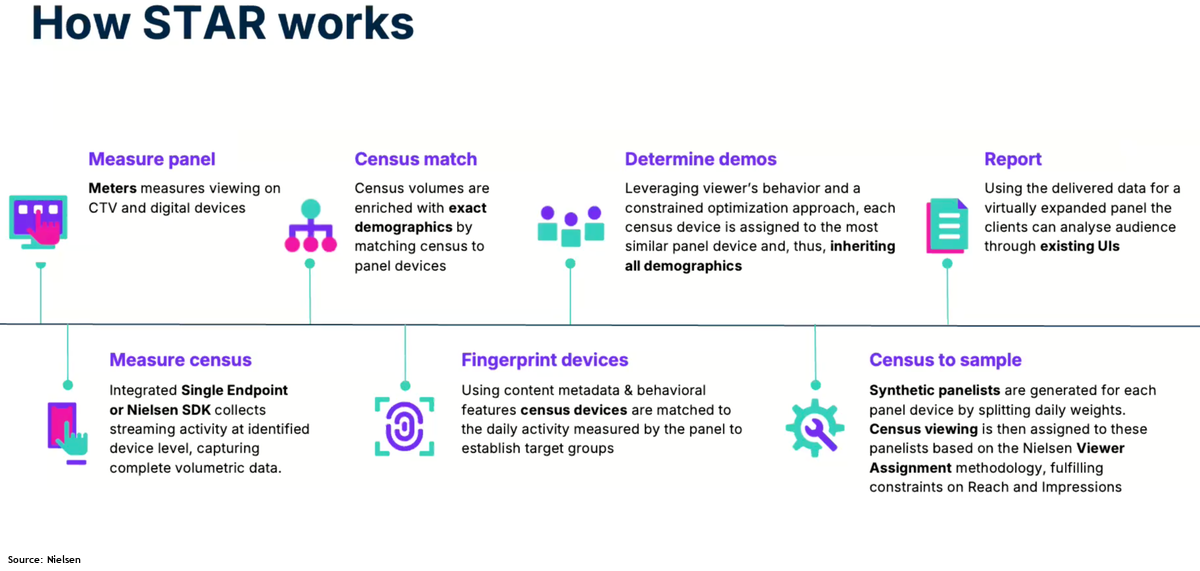
The methodology, which Nielsen calls "STAR" (Synthetic Total Audience Ratings), has actually already been
deployed in other markets outside the U.S. -- specifically Denmark.
Nielsen executives gushed that it shows great promise as a solution for how it measures viewing in a hyper-fragmented --
indeed, and virtually atomized -- marketplace of streaming services across an array of connected TV (CTV) devices that its antiquated panel-based system cannot possibly keep up with, even with the
added plus of Big Data bolted onto it.
I won't digress about that part, because we and others have covered it ad infinitum, but one of the angles I've been trying to organize is just how
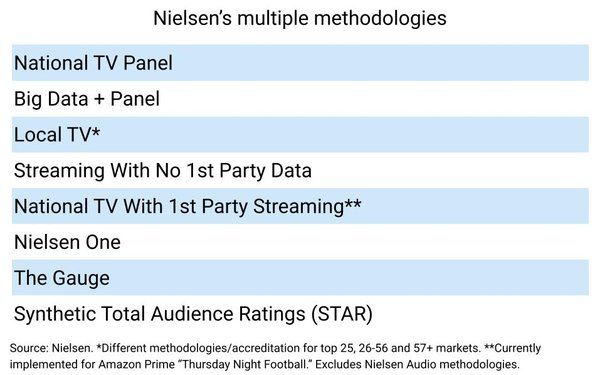
fractured Nielsen's own methodological approaches already are.
I even tried organizing Nielsen's current methodological array in this table below, but the truth is that there are multitudes of
methods beyond it.
This comes in stark contrast to its chief competitors -- especially JIC-certified Comscore, iSpot and Videoamp, which each use their own single methodology.
But for now, let me focus on what Nielsen's new
synthetic approach to audience measurement actually is, and what you might expect when it begins rolling out these new products early next year.
“We are creating a synthetic
panel,” Nielsen Senior Vice President Data Science David Kurzynski shared with a roomful of ad industry researchers during a breakout session at the Advertising Research Foundation's conference
in March.
He went on to explain a convoluted method that effectively combines two disparate databases: the proprietary log-file data generated by streaming platforms when they serve content to
an individual's or household's screen and Nielsen's proprietary household panel data.
The method is not actually synthetic in the way industry researchers customarily use the term these days,
which means that it is using synthetic AI-generated respondents trained to behave like "digital twins" of actual human respondents.
Or as then Nielsen Chief Research Officer Pete Doe explained
to the ARF attendees, the STAR method is more like a synthetic form of "fusion" -- a well-worn method based on matching respondents in two different databases based on their similarities or common
"hooks" in order to combine the insights and information about them.
The reason Nielsen's new method is labeled as synthetic is that it fuses generally matched respondents in disparate
databases one-to-one or with very little weighting involved.
In Nielsen's STAR method, Nielsen is utilizing a synthetic model that effectively splits its 40,000-household panel -- potentially
80,000 devices -- upwards of 30 times in order to match them with "millions" of people/devices in a streaming provider's server data.
Nielsen's Doe and Kurzynski characterized the adjustment
weight of that process as a magnitude of 1,000 x, which explains why Nielsen is calling it synthetic.
To be fair, as big a mathematical leap as that may seem, the Nielsen execs pointed out
that the STAR method has already won at least one industry award overseas -- presumably in Denmark -- and the methodology includes George Ivie, CEO of industry ratings watchdog the Media Rating
Council.
Curiously, Nielsen originally planned to have the MRC audit its STAR methodology this past summer as a step toward accreditation, but pulled the plug at the last minute.
Nielsen is expected to re-submit the methodology to the MRC's accreditation process in 2027, although based on its most recent announcement, it may have fine-tuned it in some way, or is at least
branding it as something else.
As high a concept as Nielsen's synthetic ratings approach may seem, a form of it already exists in the marketplace.
It has been nearly two years since
the MRC accredited a similar first-party data integration with Amazon Prime to generate ratings estimates for its "Thursday Night Football" advertisers.
And while that met with some
controversy -- not to mention confusion -- among some industry players, it's more or less baked in now as a valid method for a streaming platform combining its server log data with Nielsen panel data
to generate accredited marketplace ratings.
Interestingly, a well-informed source confirmed with me that Nielsen has pitched the other major NFL broadcast and cable telecasters to do the same,
because a significant and growing share of their audience is now coming from their own streaming platforms, but they so far have passed due to the exorbitant "eight-figure" fees Nielsen wants to
charge them for it.
In fact, the source estimates the traditional NFL telecaster like Fox or NBC is giving up a 15% methodological audience deficit to Amazon Prime by not doing so, but that
their ROI analyses -- or desire not to set a new precedent for Nielsen fees -- so far has kept them from doing it.
But the Amazon Prime method, STAR -- and whatever other first-party data
integrations Nielsen manages to bring to market -- set another kind of precedent for the advertising and media industry that I think is worth considering.
I called it "bespoke ratings" because
the ratings generated by the method -- while utilizing the same, consistent process -- are based to some degree on the streaming providers' own, proprietary audience data and therefore are
bespoke.
During their ARF briefing, Nielsen's Doe and Kurzynski alluded that Nielsen will also create some framework for providers across all platforms to be measured on an even-market
share-playing platform, but they did not go into details about how that would work, much less how valid it would be.
If you ask me, it means the ad industry will be comparing more apples to
oranges than it has in the past when it comes to comparing audience shares.
As my source notes, advertisers and agencies already are comparing broadcast network NFL audience shares directly
with Amazon Prime's synthetically inflated numbers and many of them may not even know the difference.
By the way, this is not unique to video. Nielsen already has been altering the
audience-share math for other media it measures audience shares for -- namely audio, including radio. And it has been doing it for economic reasons, not for the good of advertisers, agencies or the
media industry.
It has been nearly 20 years since Nielsen adopted a "subscriber-first" business model for reporting radio and audio listener shares.
In other words, Nielsen now only
reports shares for those providers that pay it for its service, creating marketplace voids -- both stations and platforms being omitted from local and national markets, as well as at least one entire
market: Puerto Rico, which Nielsen said it will discontinue measuring in December because none of the stations in the market are paying for its service.
Puerto Rico is the 17th-largest media
market in the U.S., according to Nielsen.
Radio industry execs I have spoken to recently also see this as a shift toward a form of bespoke audience measurement, because only those who are
paying customers will get rated.
While radio's "subscriber-first" Nielsen dilemma has been taking place for a half dozen years, it has come to a head recently, because stations, networks, and
trade associations believe the media-buying community is not fully aware of it.
In late August, the Radio Advertising Bureau and the National Association of Broadcasters sent joint letters to
Nielsen CEO Karthik Rao calling on Nielsen to eliminate its subscriber-first policy in order to make its audience measurement more representative of the entire market -- and all markets.
But
so far Nielsen has not responded, other than suggesting it may release "the math" so advertisers and media buyers can figure out their own audience share estimates for the missing stations and
markets.
Nielsen's push to bespoke, subscriber-first, first-party data and synthetic business models may seem like heresy to old-school planners, buyers and researchers who put stock in the
research provider's historic pursuit of methodological purity and marketplace representativeness.
But even as it claims in its most recent press release that the goal of these new products
will be to create a "unified" view of the marketplace, it is focusing more on individual providers paying it for service than on the marketplace planning and buying inventory based on a unified view
of the entire marketplace.
"The goal of this suite of future products," private equity-owned Nielsen says in its press release, is to provide "broader coverage, establish competitive
information symmetry, and a trusted, independent third party solution for publishers to use to make audience claims."
It's also worth noting that Nielsen's "publisher"-centric orientation
comes as advertisers are deploying their own cross-platform measurement platform -- the Association of National Advertisers' Aquila service -- to do the opposite: to provide a consumer-centric view of
how their ads are being seen by people watching, seeing or listening to their ads across platform content.
"And it really has to be," Publicis Media Executive Vice President-Research Helen
Katz said during an Aquila panel discussion at the ANA's recent measurement
conference, noting: "ultimately because we're measuring consumers here. We are measuring what media they are using and they're not differentiating between 'Oh, this is display and this is podcast,'
you know. And this structure will help enable us to do that."
What I don't understand in Nielsen's new business model orientation is not why it's working hard to cultivate new markets and
customers being generated by the shift in consumer media behavior -- it's why Nielsen has been deprecating its traditional customers in the process.
Historically, when a new media technology
began disrupting the market -- say, the advent of cable, satellites, etc. -- if anything, Nielsen bent over backwards to preserve the market stability of its preexisting clients, not the other way
around.
Nielsen has recently abandoned other parts of radio measurement, including the shutdown of its Sigma advertising and PSA monitoring service.
And for me, the biggest deprecating
narrative of all has been its push to promote the dominance of streaming platforms over linear broadcast and cable TV outlets.
I mean, even after the MRC called on Nielsen to adopt necessary
methodological changes -- including its use of an independent, third-party measurement for its media universe estimates, the core granule of all its measurements -- Nielsen a) acknowledged the flaw,
b) began incorporating the ARF's DASH service to recalibrate it, and c) decided to nonetheless continue publishing the flawed data touting streaming's dominance for months vis a vis its monthly Gauge
report.
In the next week or so, Nielsen will finally publish the first of its recalibrated Gauge reports using the DASH estimates and representing audience shares for the month of
September.
It will be interesting to see what that actually shows up as, especially since Nielsen has subsequently begun adjusting and re-weighting the DASH estimates it is using the
adjust and re-weight its ratings.
I'm not saying that has been a willful misrepresentation of the advertising and media marketplace. I'm just saying I don't understand, and Nielsen has
never explained why it continued to publish knowingly flawed data when it had the correct version.
On that final note, I'd like to point out that Nielsen's early 2027 new products announcement
ends with this statement:
"Following the completion of rigorous testing and strategic introduction, the new product suite will also eventually inform an array of key reports issued by Nielsen,
including future versions of The Gauge."